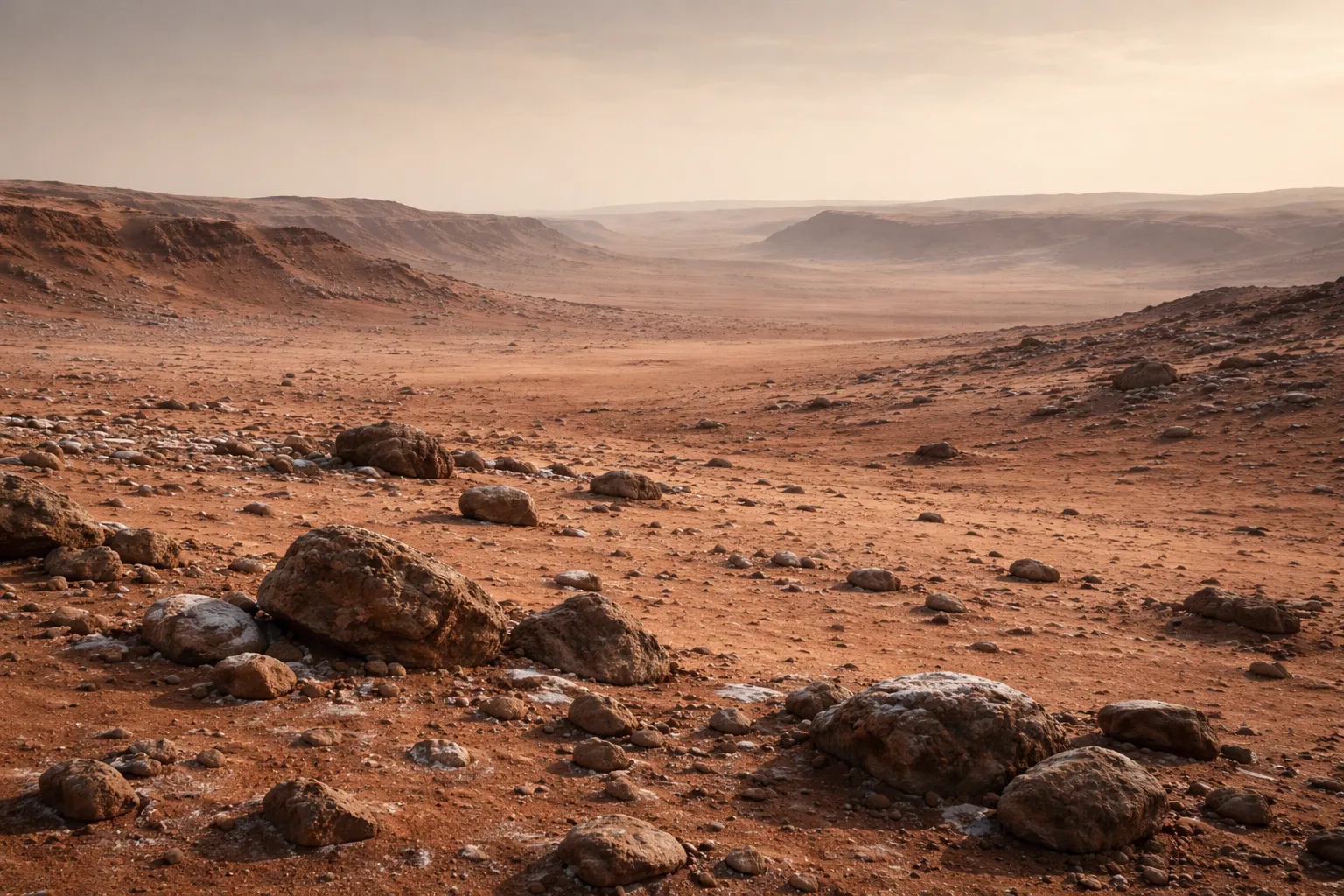
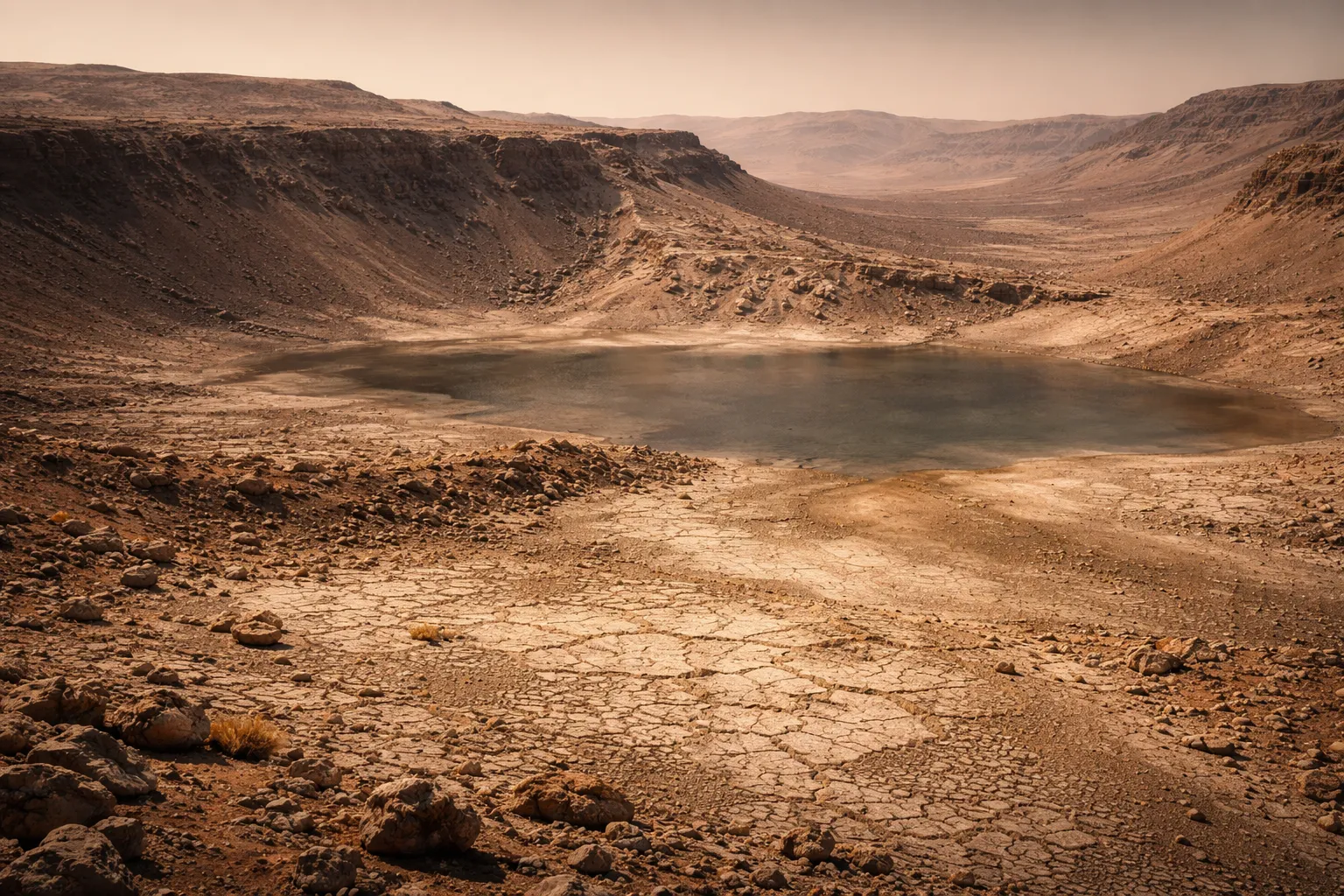
Mars today is a cold desert. Its average surface temperature is around minus 60 degrees Celsius. Its atmosphere is about 100 times thinner than Earth’s — too thin to support liquid water on the surface for any length of time. If you poured a glass of water onto the Martian surface, it would instantly boil away or freeze, depending on where you were standing.
And yet the evidence for a wetter past — and a wetter present — keeps accumulating. Mars almost certainly had liquid oceans billions of years ago. And in 2018, European scientists detected what appears to be a lake of liquid water beneath the southern polar ice cap, right now, today, on a planet we have long assumed to be dry.
The Ancient Oceans
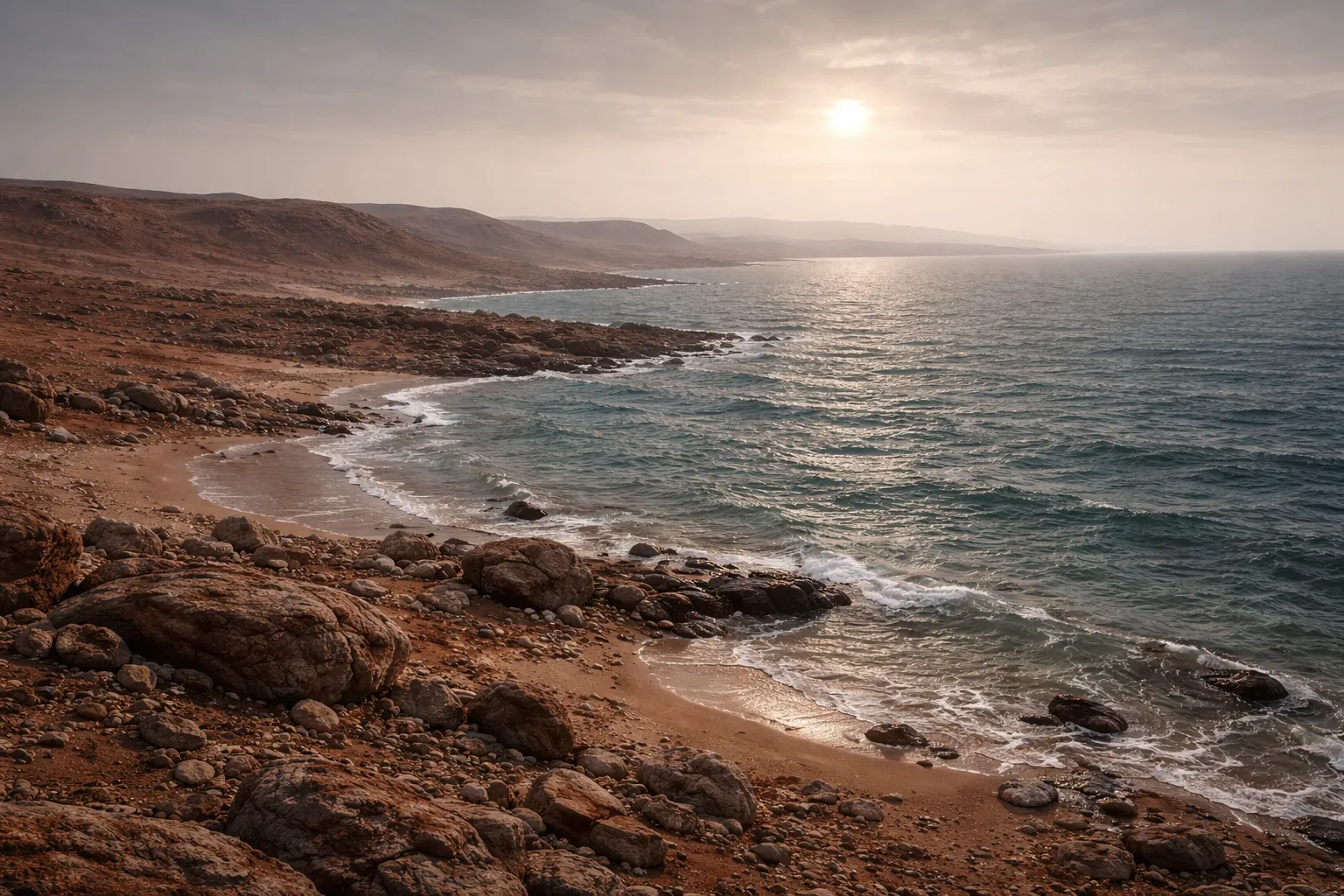
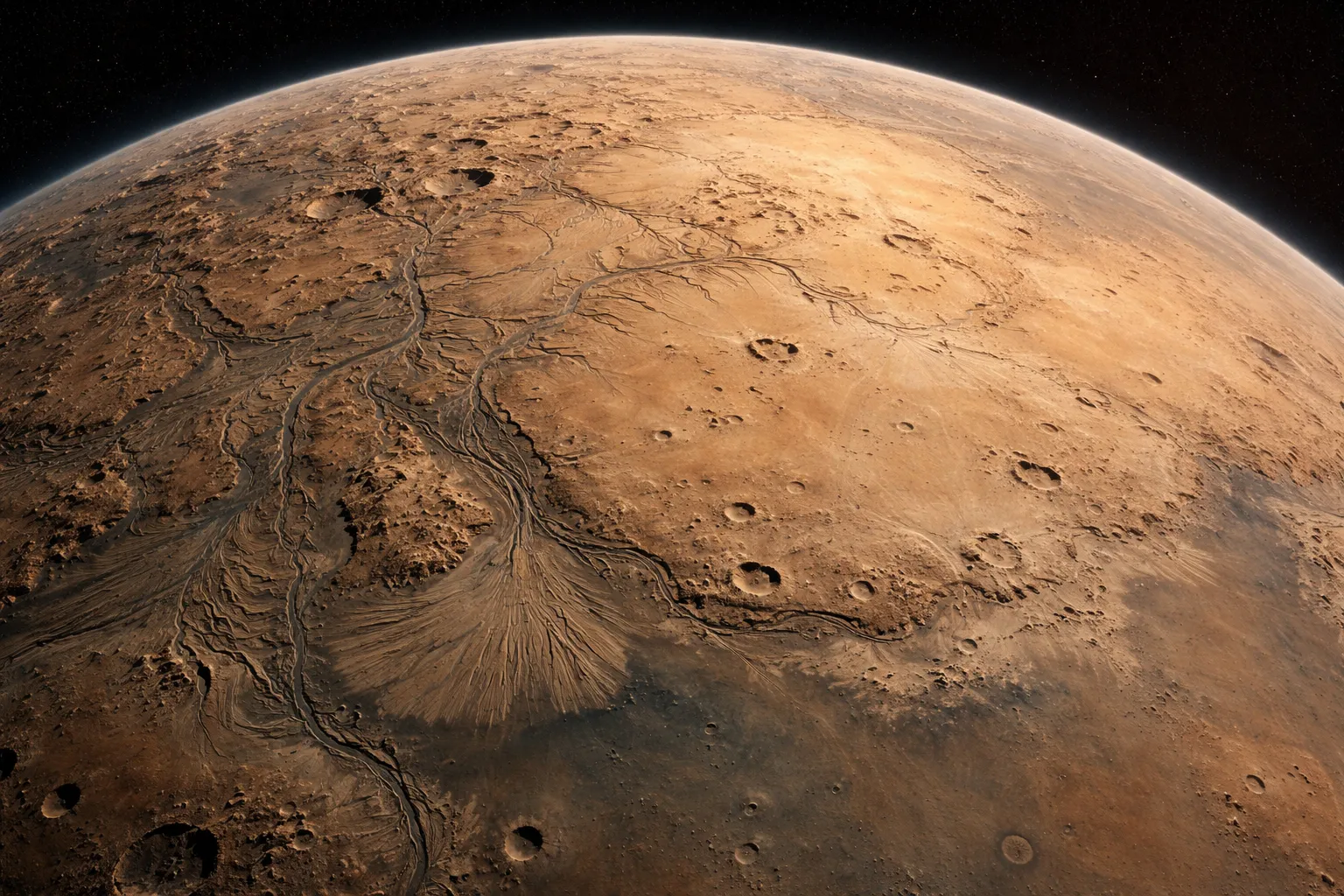
The first Mars missions in the 1970s already hinted at a wetter past. Viking’s cameras revealed what looked like river valleys and flood plains — channels cut by flowing water across a planet that has no liquid water on its surface today. The question was when this water existed and where it went.
Later missions provided more detail. The Mars Reconnaissance Orbiter mapped vast plains in the northern hemisphere that look exactly like ocean floors — flat, smooth, and bounded by what appear to be ancient shorelines. Spectroscopic analysis found clay minerals that only form in the presence of water. The Mars Science Laboratory, better known as Curiosity, found rounded pebbles inside Gale Crater — the kind of smooth, rounded stones you find in riverbeds on Earth, formed by sustained water flow, not by a brief flood.
The most recent models suggest Mars had a substantial ocean about 3.5 to 4 billion years ago, during a period called the Noachian era. This ocean may have covered much of the northern hemisphere. What happened to it is still debated, but the leading explanation involves the loss of Mars’s magnetic field. Without a magnetic field, the solar wind gradually stripped away Mars’s atmosphere. As the atmosphere thinned, the planet cooled and the water froze or escaped to space.
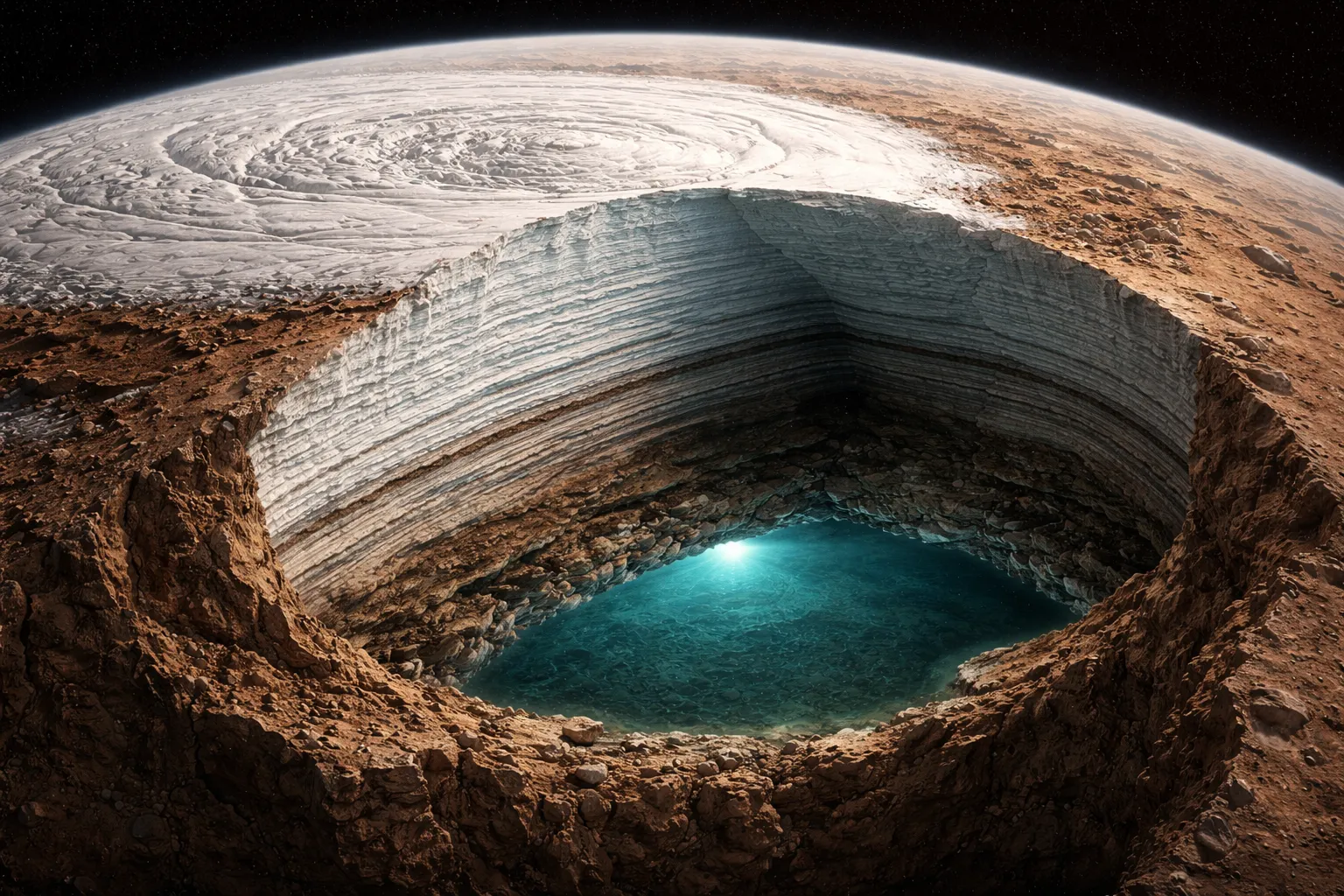
A lake of liquid water, one kilometer beneath the southern polar ice cap. Not ancient geology. Present tense.
The 2018 Discovery
In July 2018, a team from the Italian National Institute of Astrophysics published a paper in the journal Science announcing a significant finding. The Mars Advanced Radar for Subsurface and Ionosphere Sounding instrument aboard the Mars Express spacecraft had detected a bright radar reflection about 1.5 kilometers beneath the southern polar ice cap.
The reflection was characteristic of liquid water. Specifically, it suggested a lake roughly 20 kilometers across, kept liquid by the pressure of the ice above it and possibly by dissolved salts that lower water’s freezing point significantly. The temperature at that depth is estimated to be around minus 68 degrees Celsius — cold enough to freeze fresh water solid, but potentially liquid if the salts are concentrated enough.
The discovery was not greeted with universal celebration. Several researchers questioned the interpretation, pointing out that other materials could produce similar radar reflections. Follow-up analysis by different teams using the same data reached different conclusions. This is how science works, and the debate has not been definitively resolved. But the initial detection stands as the strongest evidence yet for present-day liquid water on Mars.
Why This Matters for Life
On Earth, life exists wherever liquid water exists. We have found microorganisms in hydrothermal vents at the bottom of the ocean, in highly acidic pools, in the ice of Antarctica, in the hypersaline water of the Dead Sea. In almost every environment on Earth where liquid water is present, something is alive in it.
The subglacial lake beneath Mars’s southern pole is analogous to Lake Vostok in Antarctica, which is also buried under kilometers of ice and also kept liquid by pressure and geothermal heat. Despite being isolated from sunlight and the surface atmosphere for millions of years, Lake Vostok has been shown to contain microbial life.
We have not found life on Mars. It is important to be clear about that. What we have found is a plausible environment where life could exist if it ever got started there. Given that Mars was almost certainly wetter and warmer in its early history, and given that life appeared on Earth very quickly after conditions allowed, the question of whether Mars ever had life — and whether anything might have survived underground as conditions deteriorated — is a genuinely open scientific question.
The Search Continues
The Perseverance rover, which landed in Jezero Crater in February 2021, is specifically designed to look for biosignatures — chemical or physical evidence of past life. Jezero was chosen because it appears to have been a lake with a river delta billions of years ago, exactly the kind of environment where life might have concentrated and left evidence behind. Perseverance is collecting samples that are designed to be returned to Earth by a future mission for detailed analysis in laboratories that no rover can replicate.
If microbial life ever existed on Mars — even billions of years ago, even long extinct — the implications would be profound. It would suggest that life is not some extraordinary accident that happened once on one planet, but something that emerges whenever conditions allow. It would change the probability we assign to life elsewhere in the universe. It would change how we think about what we are.
Mars is close enough to study in detail and close enough for us to eventually visit. Whatever secrets it holds about the origin of life — or the limits of it — are within reach. That is an unusual position to be in, and it is one humanity has only recently arrived at.